Destinations · 13 September 2026
Sardinia
Sardinia rewards travellers who look beyond the beach. Italy's second-largest island packs in a startling range of landscapes, from granite peaks and deep gorges to silent cork forests and long stretches of near-empty co
Sardinia: An Island Apart
Sardinia rewards travellers who look beyond the beach. Italy’s second-largest island packs in a startling range of landscapes, from granite peaks and deep gorges to silent cork forests and long stretches of near-empty coastline. It also holds one of the Mediterranean’s most distinctive cultural identities, shaped by centuries of isolation and a history that reaches back well before the Romans.
A History Written in Stone
Civilisations have left their mark here for thousands of years. The island’s best-known ancient monuments are the nuraghi — conical stone towers built from large blocks of rock, unique to Sardinia and dating from the Bronze Age. More than 7,000 survive across the island, some standing alone and others forming complex fortified settlements. Among the most impressive are Su Nuraxi di Barumini, a UNESCO World Heritage Site, and the nuraghe of Arrubiu.
Later arrivals added their own layers. Phoenicians and Carthaginians founded coastal cities, the Romans built roads and baths, and successive waves of Byzantine, Pisan, Genoese and Aragonese influence followed. The result is an island of walled medieval towns, Romanesque churches and Spanish-flavoured old quarters.
Landscapes of Contrast
The interior is mountainous and often dramatic. The Gennargentu massif forms the island’s rugged spine, while the Supramonte region is a limestone plateau riddled with caves, sinkholes and canyons. The gorge of Su Gorropu, sometimes called the Grand Canyon of Europe, is one of its highlights, with walls rising hundreds of metres above the valley floor.
Elsewhere, the island shifts character entirely. The Gallura in the north-east is granite country, scattered with wind-carved boulders and cork oaks. The Sinis peninsula on the west coast is flat, windswept and rich in birdlife. Inland, the Giara di Gesturi plateau is home to small wild horses, and the forests around Montiferru and Marghine offer quiet walking country far from the crowds.
Coastline and Sea
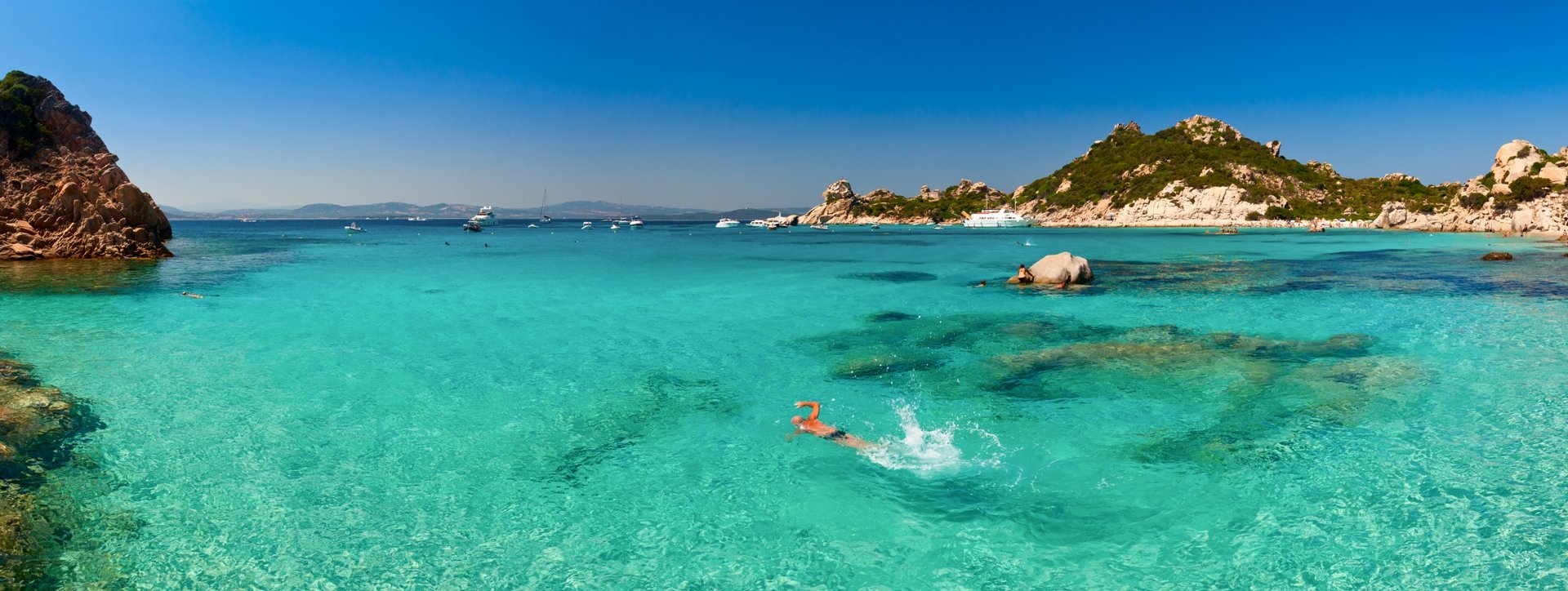
Sardinia’s coast runs for almost 2,000 kilometres, and its variety is part of the appeal. The Costa Smeralda in the north-east is the island’s most famous stretch, known for its emerald water, granite coves and upmarket resorts. Further south, the Golfo di Orosei hides beaches such as Cala Luna and Cala Goloritzè that can only be reached on foot or by boat.
The south and south-west offer longer, sandier beaches, including the dunes and lagoons around Chia, while the islands of the Maddalena archipelago and San Pietro add another dimension entirely. Diving, snorkelling, sailing and boat trips are all easy to arrange, and the water stays swimmable well into autumn.
Towns and Traditions
Cagliari, the capital, combines a lively port with a hilltop old town of narrow lanes and panoramic terraces. Alghero retains strong Catalan connections, visible in its language, architecture and cuisine. Bosa, on the west coast, is a pastel-coloured riverside town beneath a hilltop castle, and Orgosolo in the interior is famous for its political murals.
Traditional festivals remain a major part of island life. Costumed processions, horse parades and religious celebrations take place throughout the year, and the food is distinctive: suckling pig, flatbreads, pecorino cheese, and the crisp, paper-thin pane carasau. Local wines, including Cannonau and Vermentino, are increasingly well regarded.
When to Go
Spring and early summer bring wildflowers and comfortable temperatures, while September and October offer warm seas and quieter roads. July and August are hot and busy, particularly along the coast. Outside the peak weeks, much of the island feels remarkably uncrowded, and the interior is at its best in the milder months.
Getting Around
A car makes the greatest difference to any Sardinian trip. Public transport is limited outside the main towns, and many of the island’s finest beaches, archaeological sites and mountain trails are reached by narrow, winding roads. Distances can look short on a map but take longer than expected, so it pays to plan in stages rather than trying to cover too much at once.
Whether the appeal is archaeology, walking, food or simply time by the sea, Sardinia offers something that few Mediterranean islands can match: a sense of separateness that has never quite worn off.