Destinations · 13 September 2026
Sardinia links
Sardinia rewards those who look beyond the beach. The island's interior holds Bronze Age stone towers, highland vineyards and a kitchen built on roast suckling pig and paper-thin music bread, while the coast shifts from
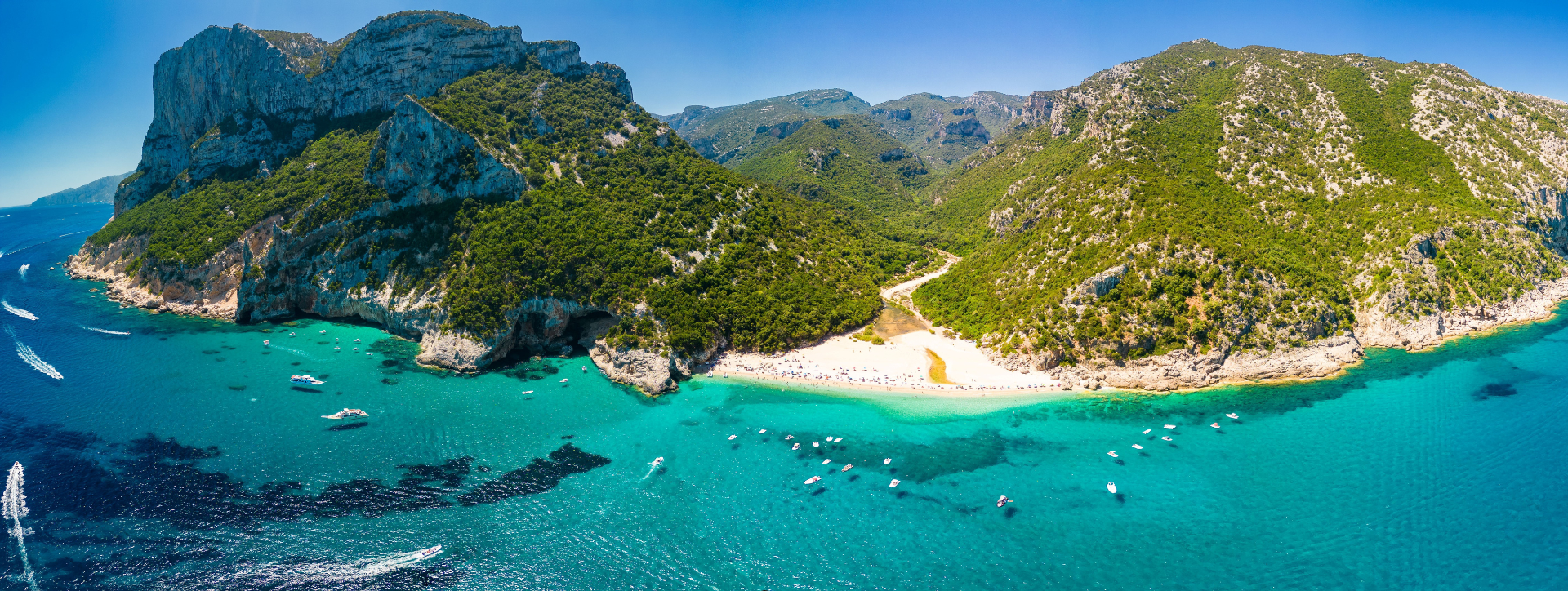
Sardinia rewards those who look beyond the beach. The island’s interior holds Bronze Age stone towers, highland vineyards and a kitchen built on roast suckling pig and paper-thin music bread, while the coast shifts from the polished marinas of the north-east to long, empty dunes in the south.
The island in brief
Sardinia is the second-largest island in the Mediterranean, sitting west of the Italian mainland with Corsica a short hop to the north. It runs roughly 270 kilometres from north to south and about 145 kilometres east to west. The coast stretches for close to 1,850 kilometres, and much of it is protected: around a quarter of the island falls within national or regional parks and nature reserves.
The landscape divides fairly neatly. The east has the granite peaks of the Gennargentu range and the deep gorges of the Supramonte. The west is flatter, with wide plains around Oristano and a string of old mining towns inland. The south, around Cagliari, mixes salt flats and lagoons with some of the island’s longest sandy beaches.
When to go
July and August are hot, busy and expensive, particularly along the Costa Smeralda. May, June, September and October offer warm sea temperatures and far more manageable crowds, and the walking and cycling are better outside high summer. Winter is mild on the coast but wet, and many coastal hotels and restaurants close between November and March. The interior, by contrast, comes alive in winter and spring with food festivals and carnival traditions.
Getting there and around
Cagliari, Olbia and Alghero all have international airports with direct flights from several European cities. Ferries run from Genoa, Livorno, Civitavecchia and Piombino on the mainland, plus Bonifacio in Corsica, arriving at Olbia, Porto Torres, Arbatax and Cagliari.
A car is close to essential if you want to see the interior. Public buses reach most towns but run infrequently, especially on Sundays and in rural areas. The island’s single motorway-standard road, the SS131, crosses from Cagliari to Porto Torres via Oristano and Sassari, and is the quickest north-south route. Elsewhere, expect slow, winding roads and allow more time than the distance suggests.
Where to base yourself
Cagliari and the south. The capital has a hilltop old town, a long city beach at Poetto and easy access to the Roman ruins at Nora and the dunes of Chia. It suits travellers who want a city base with day trips rather than a resort stay.
The Costa Smeralda and the north-east. Porto Cervo, Porto Rotondo and the surrounding coast are the island’s most expensive and most polished corner, with marinas, designer boutiques and a short season. Inland from here, the granite valleys around San Pantaleo and Aggius feel entirely different.
Alghero and the north-west. A Catalan-influenced old town, good seafood and access to the sea caves at Neptune’s Grotto. The beaches around Stintino and the Asinara peninsula are among the island’s best.
Oristano and the west coast. Quieter and cheaper than the north-east, with the Sinis peninsula, the ruins of Tharros and a strong tradition of horse riding and wetland birdwatching.
The interior. The Barbagia region around Oliena, Orgosolo and Gavoi is the island’s cultural heart, with mountain walks, murals, and agriturismi serving food from their own land.
What to see
Su Nuraxi di Barumini. The best-known of Sardinia’s roughly 7,000 nuraghe, the Bronze Age tower complexes that give the island its distinctive archaeology. The site is a UNESCO World Heritage listing and can be visited with a guided tour.
The Gennargentu and Supramonte. Sardinia’s highest peaks and its deepest canyon country, including the gorge of Su Gorropu, which can be reached on foot or by a combination of off-road vehicle and walking.
Tiscali. A ruined village tucked inside a collapsed mountain hollow in the Supramonte, reached by a demanding hike.
The Sinis peninsula. Home to the Phoenician and Roman site of Tharros, the ancient well temple of Santa Cristina and long, wind-swept beaches popular with kitesurfers.
Maddalena archipelago. A group of islands off the north-east coast, reachable by boat from Palau, with clear water and walking routes on Caprera.
Cagliari’s old town. The Castello district, the cathedral and the Roman amphitheatre, plus the city’s archaeology museum, which holds one of the most important collections of Nuragic bronzes anywhere.
Food and drink
Sardinian cooking is rural and direct. Look for porceddu, suckling pig roasted on a spit; pane carasau, the crisp flatbread also known as music paper; culurgiones, potato and mint-filled pasta; and malloreddus, small ridged gnocchi served with sausage ragù. Pecorino sardo appears in various stages of ageing, and bottarga, cured grey mullet roe, is grated over pasta along the coast.
The island has a long winemaking history. Cannonau, a red grape grown widely in the interior, is the best known; Vermentino is the main white, particularly along the north-east coast, and Vernaccia di Oristano is a fortified-style wine from the west. Mirto, a dark liqueur made from myrtle berries, is the usual way to finish a meal.
Practical notes
- Language. Italian is the official language; Sardinian and Catalan (in Alghero) are also spoken locally. English is widely understood in tourist areas.
- Money. The euro. Smaller agriturismi and rural restaurants may not take cards, so carry some cash.
- Driving. Speed limits and rules are as on the Italian mainland. Mountain roads demand attention, and livestock on the road is common in the interior.
- Walking. Many trails in the Supramonte and Gennargentu are unmarked or poorly marked. A local guide is worth the cost for anything beyond a short, obvious route.
- Beaches. Some of the best-known beaches, including those at Chia and Villasimius, have limited parking in summer and fill early. Arrive before mid-morning or use shuttle services where they exist.
- Accessibility. Not all historic sites or rural guesthouses are step-free. It is worth checking directly with any property before booking if you have specific requirements.